
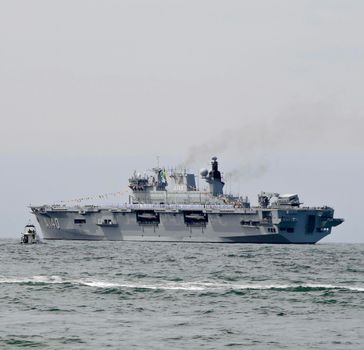
The commissioning of SLNS Samudravijaya marks a significant milestone in Sri Lanka’s naval capabilities, jointly celebrated by the United States and Sri Lanka. Such high-profile collaborations raise critical questions regarding military partnerships and their implications for regional security dynamics in South Asia.
This naval vessel, the product of South American engineering prowess, is not just a piece of equipment; it embodies a deeper strategic alignment between the US and Sri Lanka. As security concerns grow in the Indian Ocean, characterized by increased maritime traffic and heightened geopolitical tensions, the engagement of external powers in Sri Lanka’s defense narrative cannot be overstated.
Sri Lanka’s defense posture, pivoting towards the US, can be viewed through multiple lenses. On one hand, strengthening naval capabilities represents a necessary upgrade in a region where piracy, trafficking, and territorial disputes persist. The SLNS Samudravijaya could theoretically enhance operational capacity, offering the navy a better platform for both surveillance and defense operations.
However, the implications of such alliances are far-reaching. Critics express concern that over-reliance on US military support risks compromising Sri Lanka’s sovereignty. An autonomous national defense strategy may be undermined if the local navy becomes too intertwined with US operational readiness, resulting in a blurred line between support and dependency.
Moreover, the commissioning ceremony itself highlights an aspect of military diplomacy that often goes unnoticed: the optics of power. US involvement in the unveiling of SLNS Samudravijaya may convey a message of reassurance to Sri Lanka, but it also serves a dual purpose, projecting American influence in the region. As China continues to expand its footprint in the Indian Ocean, the US seeks to counterbalance its presence. This naval alliance thus assumes not just a defensive character but a strategic maneuver in the broader geopolitical chessboard.
In examining the operational capabilities brought forth by the SLNS Samudravijaya, it is important to question the long-term benefits versus the immediate military enhancement. Will this vessel and its commissioning translate into actionable advantages for Sri Lanka’s defense? Or will it merely become a symbol of foreign influence, a trophy that may come with strings attached?
In conclusion, while the commissioning of SLNS Samudravijaya is a cause for national pride and a step forward in enhancing naval strength, it must be approached with caution. The balance between sovereignty, foreign partnership, and national security remains delicate, and the real question is whether this vessel will serve Sri Lanka’s interests or those of its powerful allies.